 Neoclouds
 Neocloud Users
 AI Data Centers
 Enterprise Data Centers
 Visibility & Posture
 Verify Rented Capacity
 Risk Prioritization & Hardening
 Red Teaming & Pen Testing
 Runtime Detection & Response
 Compliance & Audit Readiness
 Blog
 Learn
 FAQ
 BMC Exposure
 Blog



TL;DR
NVIDIA’s latest Nemotron 3.5 Super VL and Lightning models outperformed leading proprietary AI models in security analysis depth while matching their accuracy in our evaluations, delivering richer security insights, high-performance inference at dramatically lower costs.
Conducted in collaboration with Highrise AI, a Hut 8 company, our research used real-world security findings and network topology from a live neocloud environment to evaluate the models’ ability to identify complex attack paths.
Even more importantly, these open-weight models can run on dedicated hardware, including on-premises, without sending sensitive data to external services.
Here’s what we found:
Real-world security evaluation: We evaluated leading open-weight and proprietary AI models using real security findings and network topology from a live neocloud environment, measuring their ability to identify four attack chains independently verified by Lava’s security research team.
100% valid paths and full attack-chain detection: NVIDIA Nemotron 3.5 Super VL and Lightning generated 100% valid attack paths and identified all four independently verified attack chains, matching the best-performing proprietary models and outperforming several alternatives.
Leading AI performance at up to 22× lower estimated inference compute costs: NVIDIA Nemotron 3.5 Super VL and Lightning matched the accuracy of leading proprietary AI models in our real-world security benchmark. By optimizing inference on dedicated NVIDIA GPUs, we achieved up to 4× higher throughput and demonstrated the potential for up to 22× lower estimated compute costs compared with Claude Opus 4.8.
Full control over sensitive data: Both models can run on dedicated hardware, including directly within customer environments, enabling advanced AI-powered security analysis without relying on external AI services.
The Challenge
Identifying complex attack paths across large-scale infrastructure is a challenging task. It requires analyzing thousands of security findings, understanding how assets such as servers, network devices, storage systems, and management controllers are interconnected, and identifying how multiple vulnerabilities could be chained together to compromise critical systems.
AI models offer a promising way to automate this analysis, but not all models can reliably connect security findings into realistic attack paths. A model might identify individual vulnerabilities correctly while overlooking critical connections, inventing nonexistent vulnerabilities, or suggesting attack paths that are technically impossible.
But accuracy was only part of the challenge.
Running security analysis at scale using proprietary AI models can be expensive. It also often requires sending sensitive data to external AI services, limiting deployment flexibility and control over sensitive data.
This raised an important question: Could open-weight AI models deliver the same level of security analysis as leading proprietary models, without the cost and deployment limitations of external APIs?
To find out, we evaluated NVIDIA’s latest Nemotron 3.5 Super VL and Lightning models and explored their performance when running on dedicated hardware.
The results challenged the assumption that advanced security analysis requires expensive proprietary models. NVIDIA Nemotron open models matched leading proprietary models in our security benchmark, while demonstrating the potential for significantly lower inference costs and full control over sensitive data.
What We Actually Tested
We wanted to answer a simple question: Can NVIDIA’s open-weight Nemotron 3.5 Super VL and Lightning models match or outperform leading proprietary AI models in identifying real attack paths, while offering the flexibility to run on dedicated hardware?
For this research, we collaborated with Highrise AI, a Hut 8 company and a leading neocloud provider. Using real security findings and network topology from Highrise AI’s environment, we evaluated leading proprietary and open-weight AI models, including NVIDIA Nemotron, Claude, Mistral, and gpt-oss.
Our goal was to understand whether AI models could accurately identify complex attack paths across real-world AI data-center environments, rather than relying on synthetic security scenarios.
Our security research team independently identified and verified four attack chains in that environment: three critical and one high-severity.
We measured four things:
Accuracy: Are the generated attack paths valid and grounded in real security findings?
Detection: How many independently verified attack chains does the model identify?
Evidence quality: How many real security findings support each attack-path stage?
Performance and cost: How fast is the model, and how much does each analysis cost?
Every generated attack path was checked against the actual environment using our production validation rules. Paths containing invented findings, incorrect asset types, malformed outputs, or impossible network connections were rejected.
“Securing AI data centers requires more than identifying individual vulnerabilities. It requires understanding how they connect to create real attack paths. Our collaboration with Lava demonstrates how advanced AI models can help uncover these risks and bring deeper security insights to complex neocloud environments.”
— Highrise
Phase One: Establishing the Baseline Through Hosted APIs
We started by comparing leading AI models through hosted APIs, primarily AWS Bedrock, including earlier NVIDIA Nemotron models.
This first phase allowed us to establish a baseline for accuracy, detection, response time, and inference costs before evaluating the latest models on dedicated hardware.
NVIDIA’s latest Nemotron 3.5 Super VL and Lightning models were not available through AWS Bedrock at the time of our evaluation, so we tested them separately in the next phase, running directly on dedicated hardware.
When AI Safety Guardrails Block Security Research
Before we could even compare the results, we encountered an unexpected challenge.
Several leading AI models, including Claude Sonnet 5.5, Opus 5, Opus 5.5, and Fable, refused to process our security analysis requests, flagging them as potentially malicious.
These were legitimate defensive security tasks, aimed at identifying attack paths using real infrastructure findings. Yet the safety restrictions prevented us from completing the evaluation with these models.
While such restrictions may be addressed through dedicated security research programs or appropriate access arrangements, they highlight an important limitation of relying on externally hosted AI models for cybersecurity applications.
Even the most advanced AI models can become unusable for legitimate security analysis when their safety guardrails block the task itself.
Initial Results
Among the models that completed the evaluation, NVIDIA’s Nemotron 3 Super matched the accuracy and detection coverage of the best-performing proprietary models, while delivering the fastest median response time at just 5 seconds and the lowest estimated cost per request.
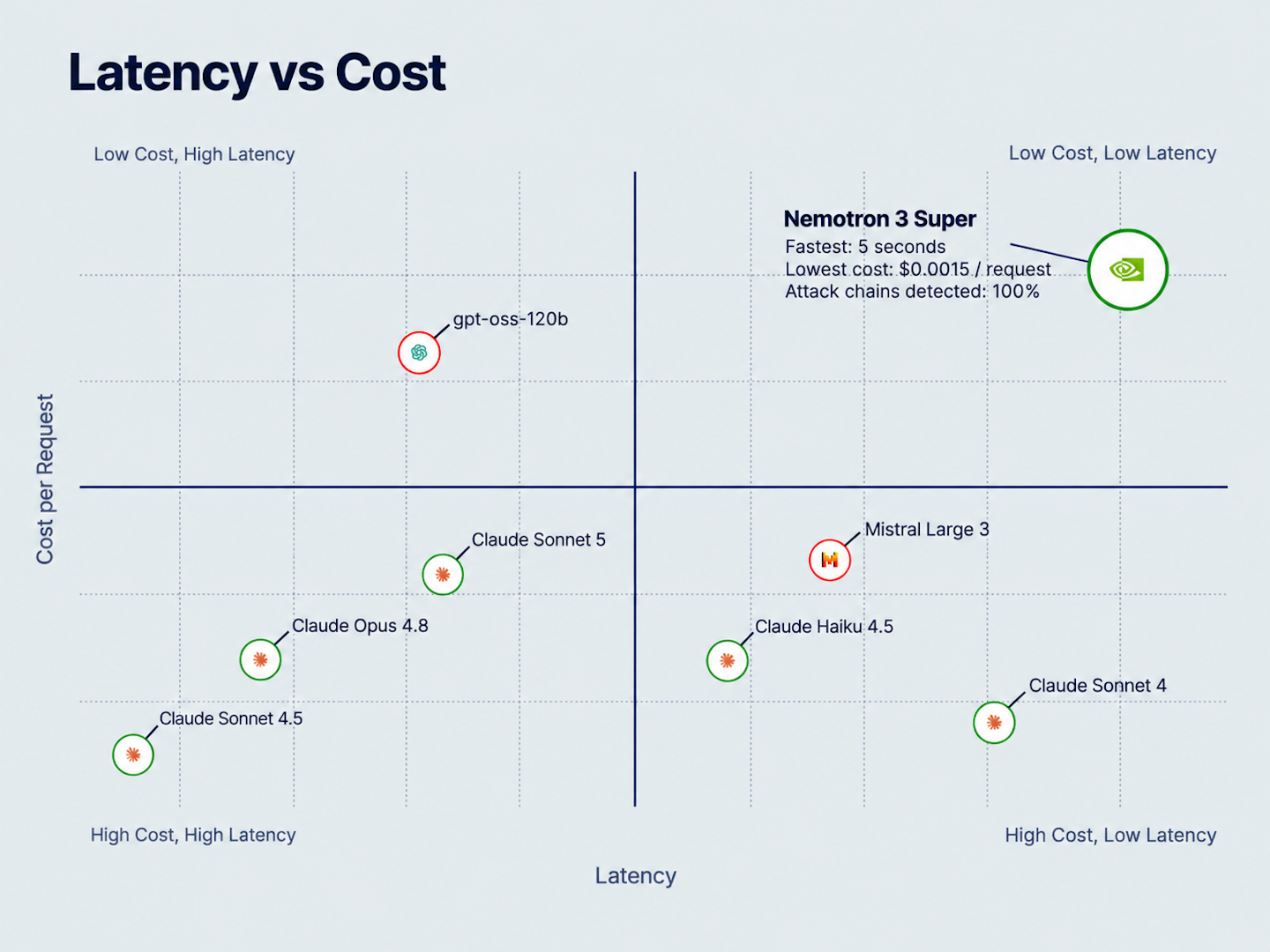
| Rank | Model | Valid Paths | Attack Chains Detected | Median Latency | Cost per Request |
|---|---|---|---|---|---|
| 1 | Nemotron 3 Super | 100% | 4/4 | 5s | $0.0015 |
| 2 | Claude Sonnet 4 | 100% | 4/4 | 19s | $0.046 |
| 3 | Claude Haiku 4.5 | 100% | 4/4 | 30s | $0.031 |
| 4 | Claude Sonnet 5 | 100% | 4/4 | 58s | $0.0616 |
| 5 | Claude Opus 4.8 | 100% | 4/4 | 47s | $0.154 |
| 6 | Claude Sonnet 4.5 | 100% | 4/4 | 92s | $0.114 |
| 7 | Mistral Large 3 | 78% | 3/4 | 12s | $0.007 |
| 8 | gpt-oss-120b | 69% | 2/4 | 43s | $0.003 |
How to read the results: Valid Paths measures the percentage of generated attack paths that passed our validation checks. Attack Chains Detected shows how many of the four independently verified attack chains each model identified. Median Latency measures response time, while Cost per Request reflects estimated API inference pricing.
But Accuracy Alone Wasn’t Enough
For us, relying entirely on external AI APIs isn’t always an option.
Our customers operate AI data centers, private clouds, and on-premises environments. Some cannot send sensitive infrastructure topology or security findings to external AI services.
We needed models that could deliver the same level of accuracy while running on infrastructure we control.
That led us to the next phase: testing NVIDIA’s latest Nemotron 3.5 Super VL and Lightning models directly on cloud GPUs, with the flexibility to deploy them on-premises.
Phase Two: Running NVIDIA Nemotron on Dedicated GPUs
After establishing our baseline through hosted APIs, we moved to the next challenge: Could NVIDIA’s latest open-weight models deliver the same accuracy while running entirely on hardware we control?
We deployed Nemotron 3.5 Super VL and Lightning on dedicated hardware hosted on Google Cloud.
We tested three configurations to evaluate accuracy, performance, and GPU requirements:
Nemotron 3.5 Lightning: Full precision on a single GPU.
Nemotron 3.5 Super VL: Full precision on four GPUs.
Nemotron 3.5 Super VL (4-bit): Quantized to run on a single GPU.
Benchmarking Nemotron 3.5 Super VL and Lightning Against Leading AI Models
Both Nemotron 3.5 Super VL and Lightning achieved 100% valid attack paths and identified all four verified attack chains, matching leading proprietary models.
But accuracy was only part of the story. The latest Nemotron models also demonstrated advantages in security analysis depth and GPU efficiency.
Two findings stood out:
Nemotron 3.5 Super VL delivered deeper security analysis - Super VL identified an average of four supporting security findings per attack-path stage, compared with two or three for other leading models. This additional context helps security teams understand not just how an attack could happen, but why it is possible and what needs to be fixed.
In our single-request benchmark, Super VL achieved a median response time of approximately 100 seconds.
Nemotron 3.5 Lightning matched leading models on a single GPU - Lightning achieved the same accuracy and attack-chain detection as the best-performing proprietary models while running on just one GPU, demonstrating that advanced security analysis doesn’t require multiple GPUs.
With a median response time of just 28 seconds, Lightning was also faster than several leading proprietary models.
Optimizing NVIDIA Nemotron for High-Throughput Inference
Matching the accuracy of leading proprietary AI models was only the first step. We also wanted to understand how efficiently these models could process security analyses when running on dedicated NVIDIA GPUs.
Rather than processing each security analysis sequentially, we optimized inference to run multiple analyses concurrently on the same hardware.
We tested configurations running 10 analyses in parallel and measured the resulting throughput improvements.
The results were significant:
2.2× higher throughput with Nemotron 3.5 Lightning: Running analyses concurrently reduced the effective processing time per analysis from 28 seconds to 12.7 seconds, allowing a single NVIDIA GPU to process substantially more security analyses.
4× higher throughput with Nemotron 3.5 Super VL: In our throughput tests, processing 10 analyses concurrently reduced the effective GPU processing time per analysis from 112 seconds to 28 seconds.
75% fewer GPUs with Super VL 4-bit: Quantizing Nemotron 3.5 Super VL allowed us to achieve comparable throughput on a single GPU to the full-precision model running on four GPUs, reducing GPU requirements by 75%.
These optimizations demonstrate that achieving leading AI performance is only part of the equation. By combining parallel inference, quantization, and efficient GPU utilization, we can significantly increase the amount of security analysis performed on the same hardware. As we show next, these improvements translate directly into more favorable inference economics.
Comparing Inference Costs: Hosted APIs vs. Dedicated GPUs
The economics of hosted APIs and dedicated GPUs are fundamentally different. With hosted APIs, costs scale with the number of requests and tokens processed. With dedicated GPUs, costs depend on hardware pricing, utilization, and how efficiently the models can process requests.
We wanted to understand how these differences translate into real costs at scale, and at what monthly analysis volume running Nemotron on dedicated GPUs becomes more economical than using hosted APIs.
Hosted API Costs
We started by estimating the cost of running our security analysis workloads through hosted APIs, primarily AWS Bedrock, using the average inference cost per analysis measured in our benchmark.
We then projected these costs across 1,000, 10,000, and 100,000 analyses to understand how pricing scales with usage.
| Model | 1K analyses | 10K analyses | 100K analyses |
|---|---|---|---|
| Claude Opus 4.8 | $154 | $1,543 | $15,430 |
| Claude Sonnet 4.5 | $114 | $1,139 | $11,390 |
| Claude Sonnet 5 | $62 | $616 | $6160 |
| Claude Sonnet 4 | $46 | $459 | $4,590 |
| Claude Haiku 4.5 | $31 | $309 | $3,090 |
| Mistral Large 3 | $7 | $70 | $700 |
| gpt-oss-120b | $3 | $27 | $270 |
At 100,000 analyses, hosted API costs ranged from $270 for gpt-oss-120b to $15,430 for Claude Opus 4.8.
Even among models that achieved identical accuracy in our benchmark, the differences were substantial. The leading Claude models ranged from $3,090 for Haiku 4.5 to $15,430 for Opus 4.8.
Self-Hosted GPU Costs
Next, we evaluated the cost of running Nemotron 3.5 directly on dedicated GPUs.
Unlike hosted APIs, where each request has an associated price, running inference ourselves allows us to process multiple analyses concurrently on the same hardware.
We compared two deployment options: on-demand instances, which provide predictable capacity at a fixed hourly rate, and Spot instances, which offer discounted compute capacity but can be interrupted.
We first calculated the cost of keeping each Nemotron configuration running continuously on dedicated NVIDIA GPUs, comparing On-Demand and Spot pricing. This establishes a baseline for predictable monthly compute costs before accounting for optimizations that allow GPUs to run only when needed.
| Model | GPUs | Monthly on-demand | Monthly Spot Cost |
|---|---|---|---|
| Nemotron 3.5 Lightning | 1 | $3,285 | $1,189 |
| Nemotron 3.5 Super (4-bit) | 1 | $3,285 | $1,189 |
| Nemotron 3.5 Super (full precision) | 4 | $13,140 | $4,758 |
These estimates assume 730 hours of GPU usage per month and exclude operational overhead. They represent the cost of keeping dedicated GPUs running continuously, regardless of how many analyses are performed.
Optimizing Spot GPU Costs with Parallel Inference
To reduce costs further, we modeled an optimized deployment using Spot GPUs that run only when needed, rather than continuously.
While Spot instances can be interrupted, their discounted pricing makes them particularly attractive for batch-oriented security analysis workloads that can tolerate interruptions and retries.
Our cost model incorporates measured inference throughput with 10 concurrent analyses and hourly execution, including GPU startup times of approximately seven minutes for single-GPU configurations and eleven minutes for four-GPU configurations.
| Model | Spot: 1K Analyses | Spot: 10K Analyses | Spot: 100K Analyses |
|---|---|---|---|
| Nemotron 3.5 Lightning | $137 | $189 | $706 |
| Nemotron 3.5 Super (4-bit) | $149 | $263 | $2,380 |
| Nemotron 3.5 Super (full precision) | $934 | $1,385 | $9,520 |
These estimates combine measured inference throughput with modeled GPU execution and startup costs. At higher workloads, additional GPU capacity can be used to process analyses within the required time window.
By optimizing GPU utilization and avoiding unnecessary idle time, we can substantially reduce inference compute costs while maintaining the flexibility to run advanced security analysis on dedicated NVIDIA hardware.
The Cost Difference: Up to 22× Lower Estimated Inference Compute Costs
Combining NVIDIA Nemotron with parallel inference and optimized Spot GPU utilization creates substantial cost advantages over leading proprietary AI APIs. Using our measured inference throughput and modeled GPU execution costs, we compared the economics of self-hosted inference with hosted APIs.
For example, at 100,000 security analyses:
| Model | Estimated Compute Cost | Compared with Claude Opus 4.8 |
|---|---|---|
| Claude Opus 4.8 (API) | $15,430 | — |
| Nemotron 3.5 Lightning (Optimized Spot) | $706 | 21.9× lower |
| Nemotron 3.5 Super (4-bit, Optimized Spot) | $2,380 | 6.5× lower |
| Nemotron 3.5 Super (Full Precision, Optimized Spot) | $9,520 | 1.6× lower |
At 100,000 monthly analyses, both Super VL configurations require two machines to meet the modeled processing requirements. These estimates include GPU startup overhead but exclude operational costs and potential Spot interruptions.
These results demonstrate how parallel inference, quantization, and optimized GPU utilization can substantially improve inference economics. Beyond cost, running NVIDIA Nemotron on dedicated hardware provides full control over where models execute and how sensitive security data is processed.
What This Means for Lava
Our collaboration with Highrise AI demonstrates why evaluating AI models against real neocloud environments matters. Security analysis must go beyond identifying individual vulnerabilities to understanding how interconnected systems, network configurations, and security findings can combine into realistic attack paths.
Our platform processes sensitive security findings and infrastructure topology across AI data centers, private clouds, and on-premises environments. Running NVIDIA Nemotron on dedicated hardware allows us to analyze this data without relying on external AI services.
As our analysis workloads grow, dedicated NVIDIA GPUs give us greater control over inference economics. We can keep compute capacity running continuously when needed or optimize costs by executing workloads on Spot GPUs, using parallel inference to process more analyses with the same hardware.
This flexibility allows us to optimize for performance, cost, and deployment requirements without depending entirely on proprietary AI APIs.
This also allows us to select the right model for each workload:
Lightning: Fast, efficient analysis on a single GPU.
Super: Deeper security investigations with richer supporting findings.
Super 4-bit: Reduced GPU requirements while preserving critical attack detection in our evaluation.
While our experiments ran on cloud GPUs, the same approach can support deployments directly within customer environments, including on-premises data centers.
We have also demonstrated the models’ accuracy and performance under controlled conditions. Sustained throughput, operational reliability, and total production costs remain important considerations as we scale.
Final Takeaway
Through our collaboration with Highrise AI, a Hut 8 company, we demonstrated how NVIDIA’s Nemotron models can deliver advanced security analysis using real-world neocloud security data.
Nemotron 3.5 Super VL and Lightning matched leading proprietary AI models in attack-path detection, with Super delivering deeper supporting security insights.
By combining parallel inference, quantization, and optimized NVIDIA GPU utilization, we achieved up to 4× higher inference throughput and demonstrated the potential for up to 22× lower estimated compute costs.
Most importantly, these open-weight models enable advanced AI-powered security analysis on dedicated hardware, including on-premises, without sending sensitive infrastructure data to external AI services.